


Interview with an award winner
TCAA 2026-2028
HAN Ishu
 Photo: SHA Hiroyasu
Profile of HAN Ishu is available here
Could you tell us how you came to develop your current artistic practice?
I was born in Shanghai and moved to Aomori when I was very young. My father liked to paint in his spare time, and I remember I was also drawing pictures from an early age. Even back then, I had a vague sense that I wanted to become a painter and pursue a path in art. There is a place in Aomori City called the Aomori Contemporary Art Centre, and discovering it had a major impact on me. It was there, when I was in high school, that I first encountered performance art. It was the first time I realized that artistic expression was not limited to painting or recreating beautiful landscapes with my own hands, but could also be connected to the society in which I lived.
I began imagining what the world around me would look like if I reimagined it through an artistic lens. Studying the works of pioneering performance artists before me, and learning through imitation, I grew eager to capture the landscapes of the world I witnessed through my own artistic practice. That was how I began experimenting with performance. Over time, my artistic practice naturally evolved to center on the body.
Could you tell us about your performances by the sea and your use of the body as a medium of expression?
Since around 2010, I have performed by the sea somewhere every year. Facing the sea alone, I would perform various actions or repeat movements drawn from my own experiences. In a sense, these works have also become a kind of video diary for me. This is a way of recording the fact of my own existence by facing the sea at different times and in different places. For me, the sea is not so much a primordial landscape as a metaphor for society. It is as though I am trying to project an image of myself onto it. My image is not literally mirrored in the sea, but through my actions toward it, I feel that I can somehow make my own presence tangible. Japan is surrounded by many different seas, and I have carried out these performances in various locations.
In these performances, I have done things such as sweeping the waves with a broom and repeating actions from my everyday life. Drawing on my experience working part-time as a security guard, I have also worn a security uniform and tried to stop the waves, or tried to till the waves as though I were tilling a field. The sea is a formless, enormous presence that cannot be controlled. By working against it or repeating ordinary actions from everyday life, I can continue to exist within those vast, turbulent waves—that is why I performed the same actions repeatedly.
The kinds of labor I have experienced in society often take place without any clear view of their ultimate purpose or of the larger whole. For example, continuing to sweep a particular place or directing people as a security guard may be only a tiny part of a much larger system. Yet we live within society without being able to see the whole picture, functioning as part of a larger social system. I, too, may be blind to the whole picture, but I still have to keep moving within it in order to survive. My work also expresses that condition.
More recently, having a family and going through those experiences has also made me increasingly aware that artistic expression is not necessarily something I create entirely on my own. I now strongly sense that the presence of many different people enters into and becomes part of my work.
-
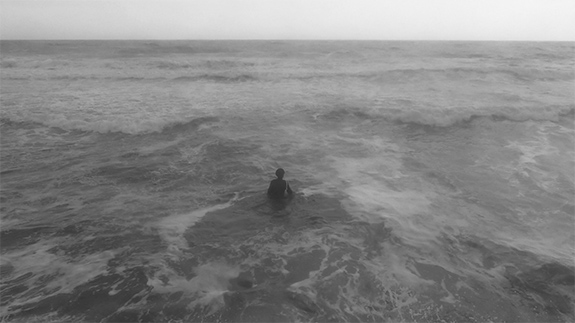
A dream about stopping the waves, 2017, single channel video
-
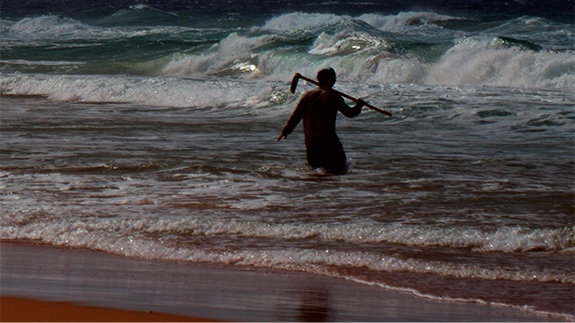
Cultivating the Waves, 2024, single channel video
During the first year after receiving the award, you will receive support for activities overseas. What are you planning to do, and what prompted you to pursue this activity?
Around 2019, I conducted fieldwork in Kobe to study the history of people who emigrated from the Port of Kobe to Brazil. I also spoke with foreign technical interns in Kobe, as well as teachers involved in Japanese-language classes at the Kobe Art Village Center (KAVC, now known as Shinkaichi Art Hiroba). In 2020, I held a solo exhibition titled “YOUR KINDNESS” at the KAVC. I see my research in Brazil this time as a continuation of that fieldwork. I myself migrated to Japan as a child, but Japan also has a history of many people emigrating overseas, with Brazil being one of their major destinations. I wanted to trace those histories myself through fieldwork, and that was the plan I proposed in my TCAA application.
From the early 1900s onward, people migrated to Brazil in different periods and under very different circumstances. Depending on which period you investigate, the very meaning of Brazil and of migration itself differs. As someone who came to Japan, I want to follow the paths of people who migrated outward from here, as I once migrated here myself. I want to think about what the place at the end of that imagined journey actually is, as well as about my own physicality as I trace those paths. Those ideas formed the basis of my plan.
Was there anything you were conscious of during the TCAA screening process?
I remember sweating a lot! I gave my presentation in meeting room at the Museum of Contemporary Art Tokyo (MOT). I mainly used my computer to show videos, and I also brought some smaller works to present. As I have had many opportunities to give artist talks and speak about myself, I was able to talk about that in much the same way as I have done before. However, because there were also international members on the selection committee, I made a conscious effort to communicate clearly who I am as a person and why I began making art.
Having created various performances and other works over the years, I felt that the TCAA had come at just the right time for the next stage of my artistic practice and for taking on new challenges. In that sense, I was extremely happy to be selected for the award.
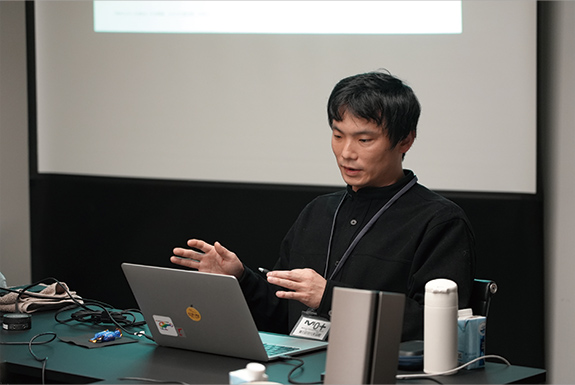
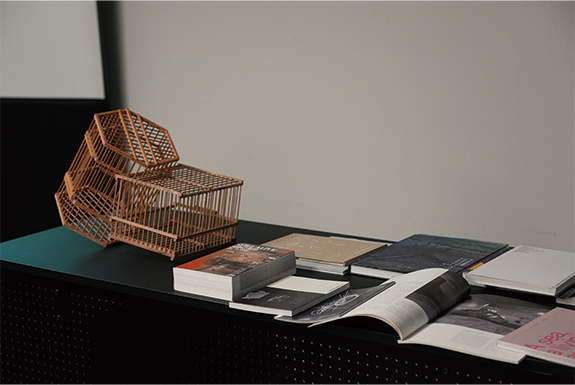
Scenes from the selection presentation
As of June 2026, could you tell us about your current ideas for next year’s exhibition?
In terms of scale, I think this will be the largest exhibition I have ever done. It will be a two-person exhibition with yang02. I have exhibited at the MOT several times before, but I have never shown such a wide range of my work in such a large space. I am very excited about how to approach that, although I also feel a little nervous. Overall, I am really looking forward to it. As for the content, I want to create various works based on what I encounter and discover in Brazil. I’m not sure if “challenge” is quite the right word, but I feel that they may be somewhat different from what I have created before. I can almost see what I want to do and what I want to express, but I have not fully grasped it yet. I’m excited about that uncertainty itself, too.
Without being too conscious of what I have made in the past, I want to hold onto the things I've always valued. First, I want to continue in Brazil the fieldwork I began in 2020, and then present at the museum whatever emerges from that process.
Video Documentation: SHA Hiroyasu
Sound: YOKOYAMA Kengo
Text Edited by Tokyo Arts and Space